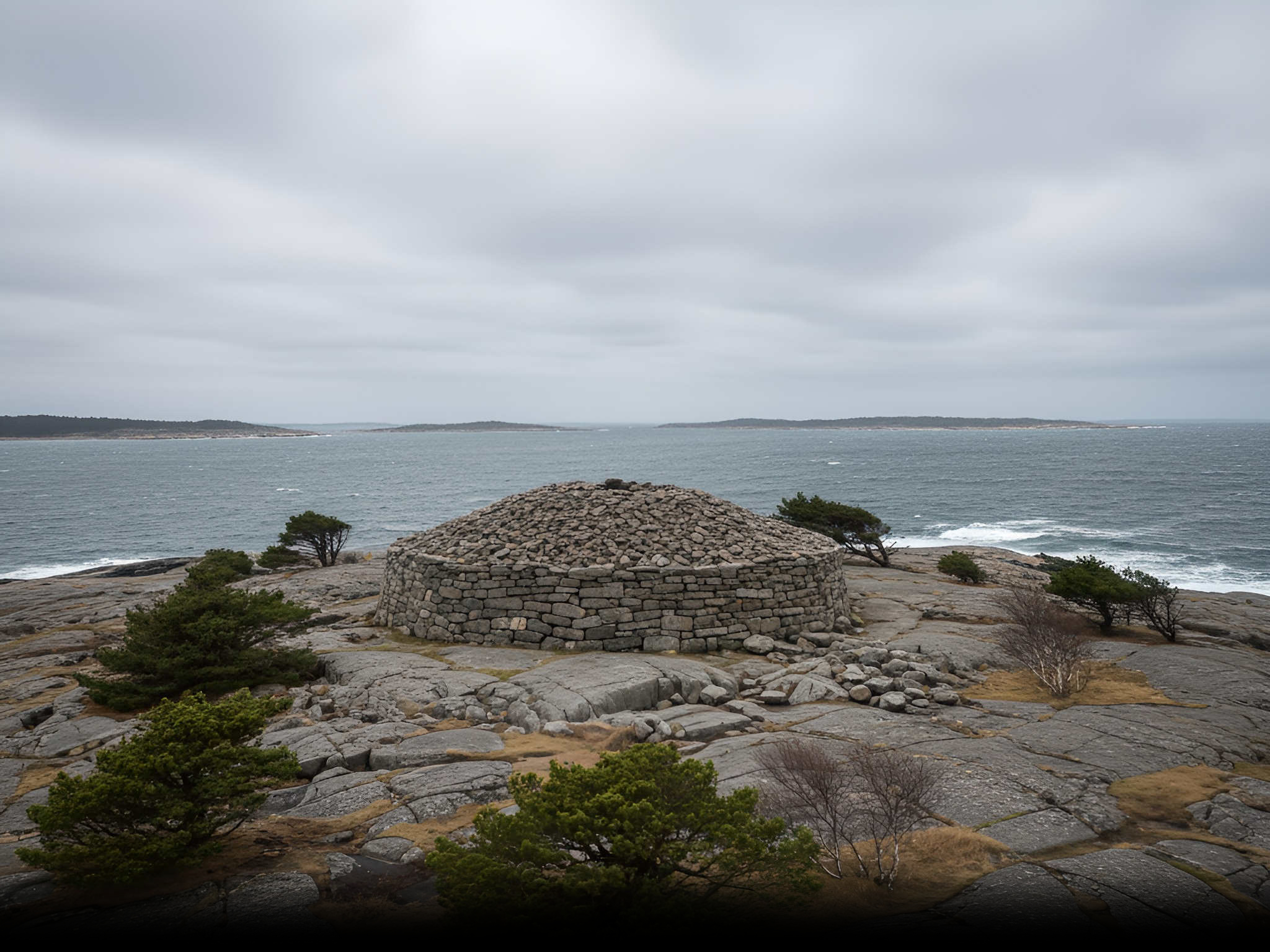
Tryggvareyrr, Sweden, circa AD 960


|
I
The saga begins in the days when the Norwegian realm was ruled AD 963
It is a lonely place for a grave. Even today there is not enough soil on the rocky hilltop for digging; if a man is to spend eternity there, he must lie above ground. Only shrubs and a few scrubby trees cling to the rocks and struggle against the bitter wind where, on the highest point of a barren, flat-topped island in Sweden’s bleak, cold Skaggerak archipelago, stands a cairn, a pile of stones some sixty feet across and eight or ten feet high. It is only about a hundred and fifty feet above sea level, but that’s enough to give the dead a clear view of the ocean to the west and the mainland to the east. The monument is thought to date from the Bronze Age, thirty centuries ago, raised over a man whose name, lost before the arrival of writing in Scandinavia, is long forgotten. No road, no path, no signs lead to it. The only way to get there is the same way men have done since the dawn of time: by foot or on horseback, across a knee-deep channel from the mainland, or in winter by crossing the ice, and climbing the steep slope to the crest. But a thousand years ago – back before these Swedish islands were part of Denmark, back when they were part of southern Norway, called Viken, or the Vik – the cairn, even then twenty centuries old, was a local landmark, known and visible to seafarers and wayfarers alike, a place where far-flung travelers could agree to come together. 
King Tryggvi Olafsson On a spring day that millennium ago, twenty men in woolen tunics with cloaks pulled tight against the ocean gusts – for if it was not a cold grey day in terms of weather, it was in spirit – made their way from the mainland, across the shallow channel to the island and climbed the hill to the cairn. Hard men these were, faces carved by wind and wave, bearing old scars, long beards and hair streaked with grey from having fought their way to the top of a brutal age. They wore armor and bore shields and weapons, too – swords, axes, spears – from bitter habit, for they were huscarls, housecarls, household troops, the personal guard of a king. The king’s name was Tryggvi Olafsson. He ruled Viken. According to Snorri Sturluson’s Heimskringla, “Tryggvi was bigger and stronger than anyone,” but then Snorri never met him, and the sagas tend to describe every hero as bigger, stronger and more handsome than every other. That said, Tryggvi was a veteran of Viking raids as far across the Western Sea as England, Scotland and Ireland, and his purpose atop the barren island this day was to lay plans for a fresh raid that summer, this time to the east, into the Baltic Sea. According to some of the sagas Tryggvi’s cousin and fellow royal, Gudrod Eiriksson, had sent heralds – messengers, envoys – with an invitation: “Gudrod told them to inform Tryggvi that he wished to become friends and partners. If Tryggvi provided ten ships he would command a third of the fleet, yet keep half of all the riches they reaped.” 
This would be more than the usual business of Scandinavian farmers setting down their hoes and scythes and taking up swords to spend the summer, as the verb goes, a-viking. It was a chance to heal a family rift among the cousins, the grandsons of the legendary King Harald Harfagri, Fairhair. Traditionally the “first king of Norway” – Nordvegr, the 1,600-mile “Northern Way” from Denmark to the whaling and fishing grounds of the Barents Sea – Fairhair in actuality had only conquered and ruled over the Vestlandet, the Western Land, the rich southwestern curve of Scandinavia, making him merely the greatest king among many. As king, his primary fault had been too many wives and consorts, and by them too many sons. “Many kings descended from him,” recorded the 14th century Icelandic chronicler Berg Sokkason. “They ruled various regions, large realms, or islands.” Fairhair’s eldest son, Eirik, had been bequeathed overall rule but became reviled, in no small part due to the machinations of his wife, Gunnhild. According to some sources raised by wizards in Norway’s far north, in others a Danish princess, according to the anonymous, almost certainly biased Agrip af Noregskonungasogum, “Summary of the Norwegian Kings’ Sagas,” it was she behind Eirik’s evil ways:
Of all women, Gunnhild was the most beautiful, not tall but extremely crafty. She became so evil in her advice, and he so easily led to cruelty and oppression of the people, that it was difficult to bear…. He became called Bloodaxe, because he was so cruel and ruthless, mostly at her direction. 
Eirik Bloodaxe: 
Hakon the Good: As he thinned the ranks of possible rivals, Eirik earned another nickname: Brother-Slayer. By murder, battle, or suspicious circumstances his all died except the youngest, his half-brother Hakon, who for his own safety Fairhair had sent to be raised in England. Grown to manhood, Hakon had returned to drive Bloodaxe and his sons out of Norway. To be known as “the Good,” Hakon was only about twenty and had no sons, but named his various dead brothers’ sons as kings – petty kings, chieftains really; Norwegians awarded the title of king to any man who could lead others. As Berg put it, “We speak of those who ruled on the coast and as supreme kings of the land, but in the highlands and hinterlands there were lesser kings descended from Harald who ruled. These realms were often beyond mountains and forests. Among these kings the most distinguished and famous descended from King Harald was King Tryggvi.” Tryggvi’s father Olaf, a son of Fairhair, had been a king himself, one of those brothers slain in battle by Bloodaxe. King Hakon had entrusted Tryggvi to fight off the Danes and raiders plaguing southern Norway. These raiders were the Eirikssonnene, the sons of Bloodaxe. He had died in England, and the English had expelled them much the way Hakon had expelled them from Norway. They might now be more rightfully called the Gunnhildssonnene, for they had found safe haven with their mother Gunnhild in Denmark. The Heimskringla, the “Circle of the World” history of Scandinavian kings written by 12th century Icelandic historian, poet and politician Snorri Sturluson, tells us, “Eirik’s sons then turned with their army north to Viken and raided there, but King Tryggvi sailed with his army to meet them. They fought many battles with the victory going first one way, then the other. Eirik’s sons sometimes raided Viken, and Tryggvi sometimes around Halland and Zealand.” One might have thought Hakon and the sons of Bloodaxe would get along strictly on the basis of common religion, for during their time in England all had become believers in the Hvitakrist, the “White Christ.” “King Hakon was a faithful Christian when he arrived in Norway,” confirms his saga, “but because the land was heathen, with many pagan worshippers among the chieftains, he felt he lacked support and approval among the commoners, and chose to practice his faith in secret, on Sundays and Friday fasts.” The Norwegians were happy in their paganism. Hakon’s most powerful jarl, Sigurd Hakonsson of Hlade, modern Lade near Trondheim,* was practically his co-king, but knew better than to go against the old gods. In fact, he threw a great feast in their honor, footing the entire bill himself. According to the Heimskringla, Everyone brought ale to this festival, and many cattle and horses were slaughtered, with the blood taken from them called hlaut, and the jars in which it was saved called hlaut-jars. Hlaut-pieces were made, like sprinkling brushes, with which all the altars and temple walls, both outside and inside, were sprinkled, and the people too were sprinkled with the blood, but the meat was boiled into savory stew. 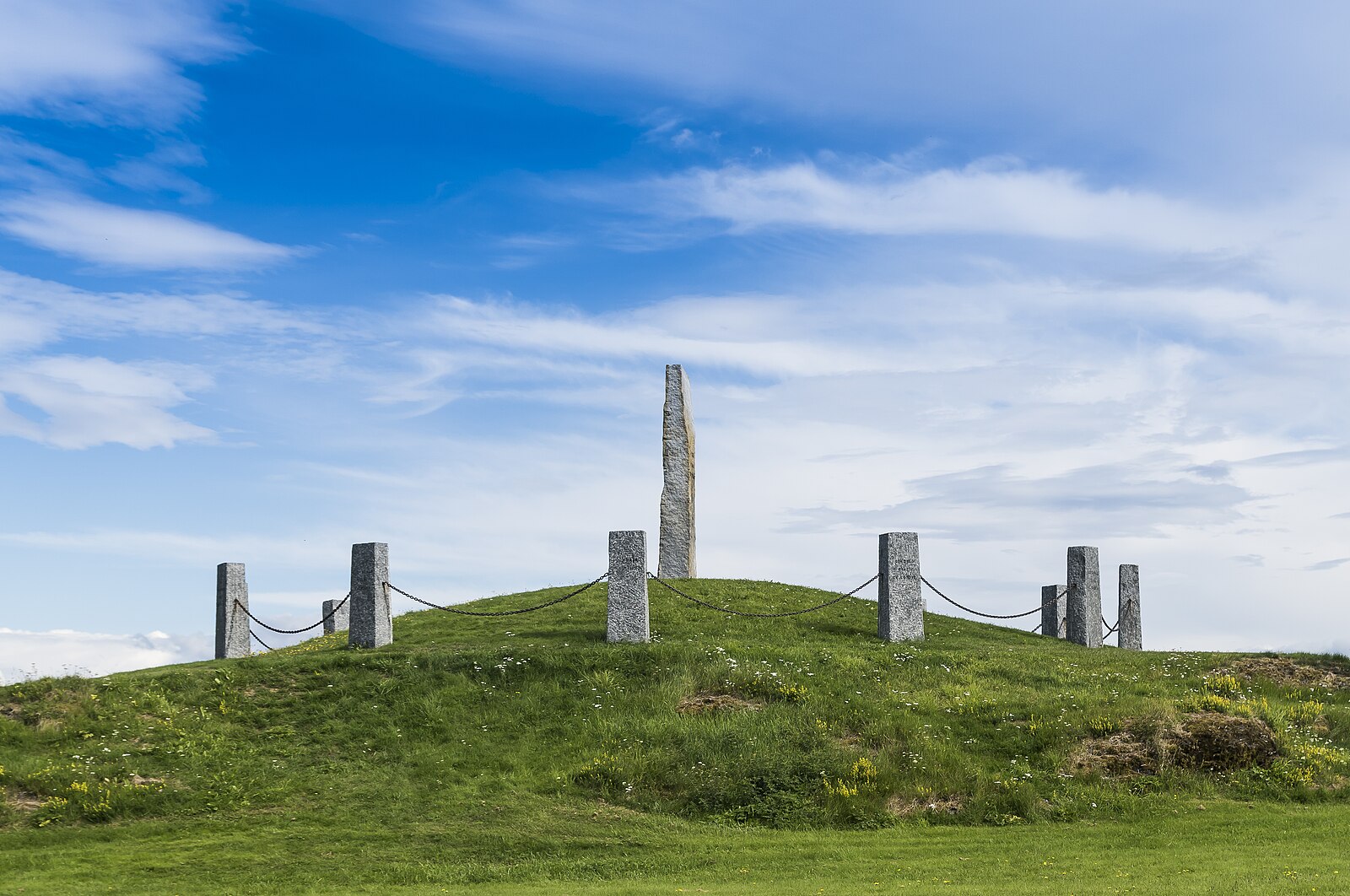
Tinghaugen Hakon would have done best to keep his Christianity to himself. Things began to sour the moment he tried to impose it upon his subjects. In 950 he attended a thing, a proto-democratic convention, atop Tinghaugen, “Assembly Hill” across the fjord from modern Trondheim. Hakon announced his intention that all the people should abandon the pagan gods, undergo baptism and put their faith in Christ. After a murmur from the crowd, one among them rose as spokesman: “If you insist on this business to the point of forcing it on us like a tyrant, then we farmers have all decided to break with you and raise up another king who will allow us freedom of religion.” Hakon the Good was too good to force his faith on Norway. He backed down, and even attended sacrificial feasts, though he refused to drink to Odin, instead making the sign of the cross over his cup. (Jarl Sigurd told his confused men, “He is blessing the goblet in the name of Thor, making the sign of his hammer over it before he drinks.”) Still, Hakon’s unrepentant Christianity alienated his pagan subjects and weakened his overall power. He managed to fight off repeated incursions by the sons of Gunnhild, but in 961 they mortally wounded him in battle. His poet, Eyvind Finnson, called Skaldaspillir, “Skald-player,” wrote a dirge in which, regardless of Hakon’s submission to Christ, Odin nevertheless welcomed the blood-drenched king to Valhalla to drink ale with the old gods and sit reunited among his dead brothers: “The wolf Fenrir [the monster that would devour Odin at Ragnarok], unbound, will walk the earth before so good a king again treads the empty path.”
If the Norwegians resented Hakon’s Christianity, they feared it in his successors, the sons of Bloodaxe. “Gunnhild’s sons became Christian in England, as told before,” admits the Heimskringla, “but when they took over Norway they made no attempt to spread Christianity, merely pulling down the temples and idols and casting away the sacrifices where they could, and in doing so raising great acrimony.” The eldest, Harald, called Grafeld, Greyhide or Greycloak – but perhaps not to his face, for once setting a fashion trend by wearing faux fur made from cheap Icelandic wool – took over as King of Norway. His Norway, however, was only his grandfather’s same small slice of the western coast; even with his brothers behind him he did not have the manpower to conquer it all. “There were then many chiefs in the land,” reports Snorri. “There was Tryggvi Olafsson in the east, [his cousin] Gudrod Bjornson in the west, and Sigurd Jarl of Lade in Trondheim, but that first winter Gunnhild’s sons held the middle of the country.” Greycloak agreed to allow them all to retain their stations as his vassals, if not necessarily happy ones. “They believed they had just as strong a claim to the crown as the sons of Gunnhild,” confided Berg Sokkason. “King Tryggvi Olafsson was a great man and honorable, whom the men of Viken regarded as most deserving to rule the entire country.” 
Gunnhild Konungamodir The real ruler of Norway, however, was Gunnhild, whose hand guided her sons’ reign as much as it had their father’s. The Heimskringla declares, “She was now called Konungamodir [Mother of Kings].” She was furthermore said to dabble in seidr, Viking sorcery, using trances and visions to divine the future and manipulate fate. By such means she concluded that her nephews Tryggvi and Gudrod, Jarl Sigurd and his son Hakon were all conspiring against her sons.* The 12th-century Icelandic monk and historian Odd Snorrason has her chiding them, “You bear the titles of kings as your forefathers did, but you have piddling armies and territories and there are many claiming a piece of it.”* She professed to not understand how sons of Bloodaxe could tolerate anyone else ruling over their rightful lands. Greycloak replied that conquering Norway would not be as easy as slaughtering a calf. He and his brothers did not have the power, nor enough of the people’s love, to conquer it all. Gunnhild, whom the Historia referred to as “a vicious and most evil woman,” told them, “Then we shall devise a very different plan.” In late 962 they caught Jarl Sigurd at a feast and burned down his hall with him in it. It might be expected that to forestall blood vengeance Greycloak and his brother Gudrod would set upon Sigurd’s son Hakon and their cousins in turn, and indeed they laid plans to set out together. According to Snorri, though, before they even set sail the brothers, drunk, fell out over who was to lead. Greycloak and Gudrod almost came to blows before their men parted them, and they went their separate ways. Rumor of the split between the brothers reached Viken, probably on the tongues of Gudrod’s heralds along with his invitation to Tryggvi go a-viking.* It behooved Tryggvi to mend fences with his cousins and break the cycle of violence or, failing that, to exploit this breach in their ranks. Tryggvi’s name meant trusty, reliable; evidently he placed that same trust in Gudrod’s heralds and his proposal. According to Odd he told them, “This venture seems to me to bear promise, and it may be a good idea if there are no tricks. The sons of Gunnhild are known for it, but you appear to be good honest men.” 
“My king.” His queen, Astrid, bore no such trust. “My lord,” she told him, “I have a bad feeling about this business. I dreamed I wore a great golden armlet, but I saw it broken in two, with blood dripping from both pieces. I believe this is an ill omen and that you face treachery.” Astrid Eiriksdottir was the daughter of a stormann, a “big man,” a wealthy landowner of Oprekstad, thought to be modern Obrestad, up across the Skaggerak on Norway’s southwest coast. That she and her father were not of royal blood speaks well of the love between her and her husband, her king. Perhaps still a teen – Norse girls being considered marriageable at the onset of menstruation – she had already borne him two daughters, Astrid and Ingebjorg (probably about one and two at this point), and she was pregnant with their third child. A man of that time and place, especially a king, would have desired a son. But a good king would long more for peace. As for his wife’s dream, Tryggvi told her, “It is of no importance.”
After Tryggvi’s and Gudrod’s ships put in at the anchorage, arrangements were made for the kings to meet on suitably neutral ground and work out the details of their little enterprise. According to Odd, “Gudrod sent word to King Tryggvi, bidding him go up onto the headland with twenty men. He said he would come with an equal number to have a friendly discussion about their battle preparations.” And so Tryggvi and his housecarls waited, atop the high ground by the cairn. Meanwhile, down below, Gudrod told his men, “I think it foolish to go to such effort, risking life and property for power, rather than seize what is free for the taking without risk. We shall now go up onto the headland with forty men in order to cut up King Tryggvi’s realm among us.” His heralds, having delivered his proposition to Tryggvi in good faith, told him, “You sons of Gunnhild are shameless, treacherously confiscating the realms of your vassals and kinsmen. No honorable men will serve you, and we will depart and never aid you in this.” Gudrod replied that he would carry out his plan with or without them. (It is to his dubious credit that he let them sail away with their lives, rather than murdering them on the spot.) He took his forty housecarls up the hill to meet Tryggvi’s twenty. The sagas record no conversation, but then no words needed said. Sixty men in that little island-top arena drew blades and set to their bloody work. Odd admitted, “Even though King Tryggvi was a great fighter, he was taken by surprise, and he could not resist.” 
Whether he died fighting, or was held fast while his cousin murdered him outright, as he was a pagan we might hope that King Tryggvi Olafsson died with sword in hand, and that Odin welcomed him into Valhalla. Down in the ships, the rest of his men were likewise outnumbered two-to-one, and the outcome was the same. “After that,” wrote Odd, “Gudrod took over his realm.” And as for Tryggvi, “He rests in a cairn there on the headland, with monument stones to mark his head and feet. It is called Tryggvareyrr, Tryggvi’s Cairn.” 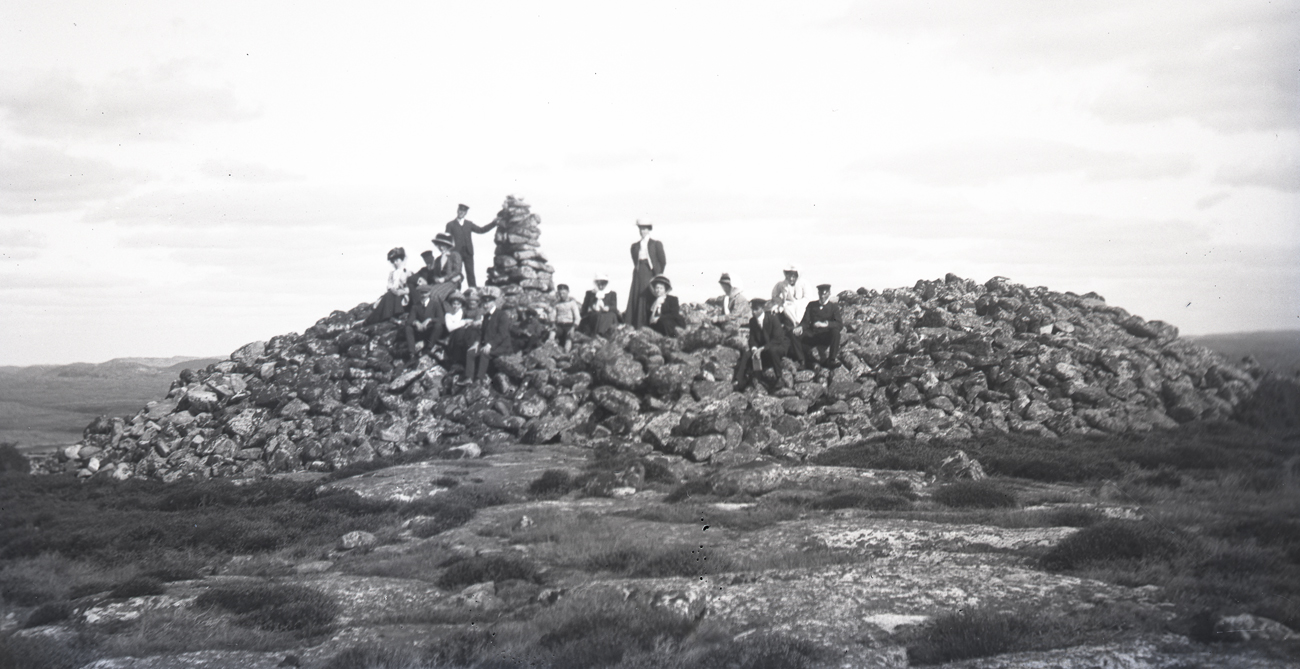
Tryggvi’s Cairn, circa 1910 By the dawn of the 20th century the mound of stones atop the island had been almost completely demolished by medieval grave robbers and later souvenir hunters. Excavations in the 1920s revealed a tomb in its heart, though so badly damaged that almost nothing remained of a body, Bronze Age or otherwise, but a few shards of bone. In memoriam, the cairn was rebuilt to what’s thought to be some semblance of the original. Today the Swedes call the island Tryggo, and the cairn Kung Tryggves Grav, King Tryggvi’s Grave. But King Tryggvi Olafsson left much more to the world than a pile of stones. 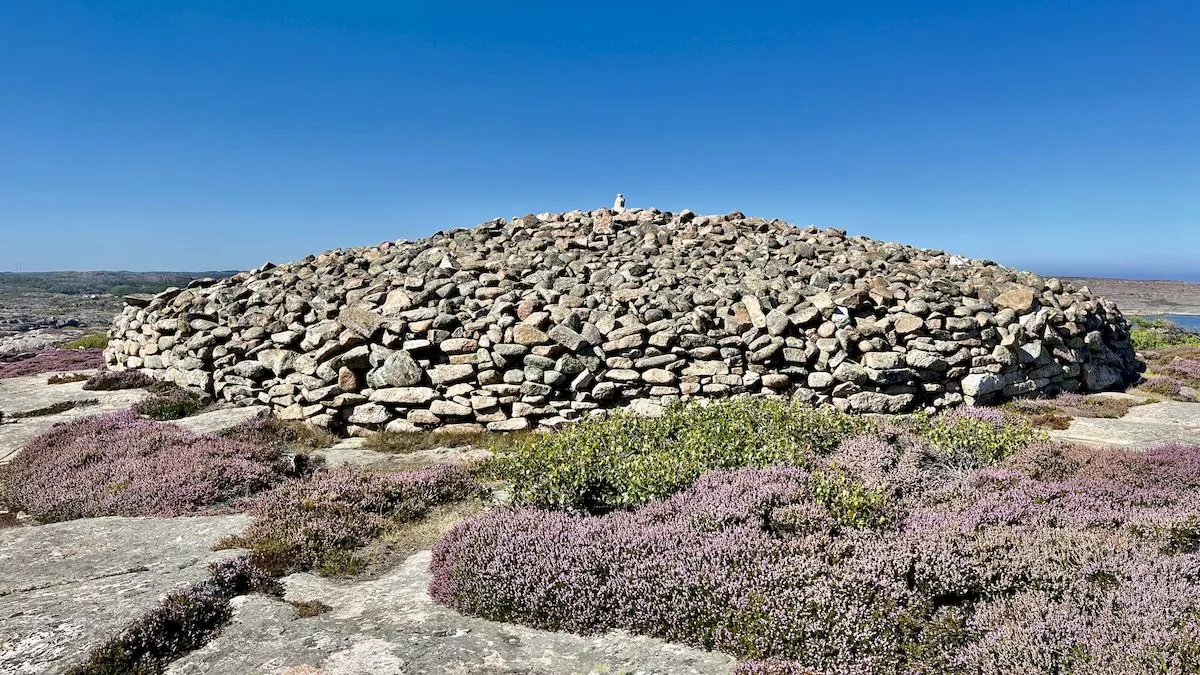
REVIEWS:
Hollway pieced together Olaf’s biography from numerous and often contradictory sources. He does a masterful job of fitting the pieces together to form a coherent picture. The result is an exciting story set in a violent era.
“Hammer of the Gods” is an exciting and engaging read that will introduce readers to a world that seems utterly fantastical, but was surely part of our own. For fans of Viking lore and history, I can hardly recommend Hollway’s new work enough.
Hollway has written a new nonfiction saga...a narrative that is not just coherent, but compelling...a sort of Viking hagiography, a kings-and-battles book that knowingly prints the legend in breathlessly dramatic episodes.
Hammer of the Gods is a veritable Scandi Game of Thrones. Don Hollway is a master at interweaving fact and fable, and this book is the third in his trilogy of Viking bio-dramas. A must-read for all lovers of the genre.
[Hollway] juggles myth, archeology, ancient texts and history without getting bogged down.... Hammer of the Gods: King Olaf’s Viking Conquest, a compendium of all the main sources pertaining to the life one of the world’s most famous Vikings, is in itself a saga—and a highly readable one.
ORDER TODAY:
• OSPREY US •
PUBLICITY CONTACTS:
REPRESENTATION
Scott Mendel, Managing Partner
About the author
Don Hollway is an historian, illustrator, historical re-enactor and classical rapier fencer. For over 30 years his writing on history, aviation, and re-enacting has appeared in magazines ranging from Aviation History, Excellence, History Magazine, Military Heritage, Military History, Wild West, and World War II to Muzzleloader, Porsche Panorama, Renaissance Magazine, and Scientific AmEirikan. Many of his articles are available free on his website, donhollway.com, where a number of them rank in the top two or three in global search results. He is a member of the Organization of Ameirican Historians and the Viking Society for Northern Research in the UK.
More from Don Hollway:
|